
WELCOME TO SUMATRA
Sumatra Culture: Discover the Rich Traditions, Tribes, Heritage, and Local Life of Indonesia's Largest Island
Sumatra is a land of extraordinary cultural diversity, where ancient traditions, vibrant ethnic communities, and breathtaking landscapes come together to create one of Indonesia's most authentic travel experiences. From the iconic Batak villages around Lake Toba and the matrilineal Minangkabau culture of West Sumatra to the Islamic heritage of Aceh and the rainforest communities of Bukit Lawang, every region offers unique customs, traditional architecture, colorful festivals, local cuisine, and centuries-old traditions. Whether you are planning a cultural journey, an orangutan trekking adventure, or simply want to learn more about Indonesia's rich heritage, this complete guide to Sumatra culture will introduce you to the people, history, traditions, arts, music, dances, and unforgettable experiences that make Sumatra one of Southeast Asia's most fascinating cultural destinations.
Sumatra Culture: A Complete Guide to the Traditions, Tribes, and Heritage of Indonesia’s Largest Island
Sumatra is one of Southeast Asia’s most fascinating destinations, not only because of its breathtaking rainforests and incredible wildlife but also because of its remarkable cultural diversity. As the sixth-largest island in the world and the largest island entirely within Indonesia, Sumatra is home to millions of people representing dozens of ethnic groups, each with its own language, traditions, customs, music, architecture, and cuisine.
For travelers, discovering Sumatra culture means much more than visiting historical landmarks or watching traditional dances. It is an opportunity to experience authentic village life, learn about centuries-old customs, taste regional specialties, and meet welcoming local communities that proudly preserve their cultural heritage. Whether you are exploring the highlands around Lake Toba, trekking through the rainforest of Bukit Lawang, enjoying the culinary delights of Medan, or visiting the traditional villages of West Sumatra, every destination reveals another chapter of Sumatra’s rich cultural story.
Unlike many islands with a dominant cultural identity, Sumatra is a mosaic of traditions shaped by ancient kingdoms, international trade, migration, religion, and the island’s extraordinary natural environment. Indian, Arab, Chinese, and European influences blended with indigenous customs over hundreds of years, creating one of Indonesia’s most colorful cultural landscapes.
Today, responsible tourism helps preserve these traditions while providing sustainable livelihoods for local communities. Visitors can participate in cultural festivals, stay in traditional villages, learn local cooking techniques, watch artisans weave handmade textiles, or accompany experienced local guides who share stories passed down through generations.
This guide explores the history, traditions, ethnic groups, architecture, music, dance, food, festivals, and cultural experiences that make Sumatra one of Indonesia’s most rewarding travel destinations.
The History of Sumatra Culture
The story of Sumatra culture stretches back thousands of years. Archaeological discoveries suggest that people have inhabited the island since prehistoric times. Its strategic position along the ancient maritime Silk Road made Sumatra an important center for trade between Asia, the Middle East, and later Europe.
During the seventh century, the powerful Srivijaya Kingdom emerged in southern Sumatra. Based around present-day Palembang, Srivijaya became one of Southeast Asia’s most influential maritime empires. Merchants from China, India, Persia, and Arabia visited the kingdom, bringing new ideas, religions, and artistic influences that blended with local traditions.
Centuries later, Islamic kingdoms flourished across northern and western Sumatra. Aceh became an important center of Islamic scholarship and international trade, while local customs continued to evolve alongside religious beliefs. European colonial powers also left their mark, particularly the Dutch, who introduced new administrative systems while many traditional communities maintained their own customs and social structures.
Despite centuries of outside influence, Sumatra has preserved many indigenous traditions. Clan systems, ceremonial rituals, traditional architecture, weaving techniques, and oral storytelling remain an important part of everyday life in many regions.
Why Is Sumatra Culture So Unique?
Several factors make Sumatra one of Indonesia’s most culturally diverse destinations.
First, the island is home to more than one hundred ethnic groups. Each community has developed its own identity, language, clothing, ceremonies, and culinary traditions. This remarkable diversity allows travelers to experience completely different cultures without leaving the island.
Second, Sumatra’s dramatic geography has shaped local traditions. High mountains, volcanic landscapes, dense rainforests, fertile valleys, rivers, and long coastlines created isolated communities where unique customs developed over centuries. Even neighboring villages may celebrate different festivals or speak different dialects.
Another reason for Sumatra’s cultural richness is its long history as a center of international trade. Merchants from India introduced Hindu and Buddhist influences, Arab traders spread Islam, Chinese merchants contributed culinary and commercial traditions, and European colonial powers influenced architecture, education, and governance. Rather than replacing local customs, these outside influences blended with indigenous traditions to create distinctive regional identities.
Perhaps the most remarkable feature of Sumatra culture is the close relationship between people and nature. Many traditional communities view forests, rivers, mountains, and wildlife as sacred or spiritually significant. This connection continues today through conservation efforts, sustainable farming, and ecotourism initiatives that protect endangered species such as the Sumatran orangutan while supporting local livelihoods.
The Major Ethnic Groups of Sumatra
One of the greatest strengths of Sumatra culture lies in its ethnic diversity. Every region offers unique customs that have been carefully preserved for generations.
Batak People
The Batak people are among the best-known ethnic groups in North Sumatra, particularly around the spectacular Lake Toba region. Rather than being a single ethnic group, the Batak consist of several distinct communities, including the Toba, Karo, Simalungun, Pakpak, Angkola, and Mandailing peoples.
Batak society places great importance on family relationships through a traditional clan system known as Marga. Every family belongs to a clan that traces its ancestry back many generations. This system continues to influence marriages, ceremonies, and community life today.
Traditional Batak villages feature beautifully carved wooden houses with dramatic saddle-shaped roofs. These houses are built on stilts and decorated with symbolic carvings representing prosperity, protection, courage, and harmony.
Music is another essential part of Batak culture. Ceremonies often feature the Gondang ensemble, consisting of drums, gongs, and wind instruments that accompany the famous Tor-Tor dance. Visitors to Lake Toba can experience these performances during cultural festivals and traditional celebrations.
The Batak people are also known for their hospitality, strong community values, intricate wood carvings, and the colorful Ulos woven cloth, which symbolizes love, respect, and blessing during important life events such as weddings and family ceremonies.
Minangkabau People
The Minangkabau people of West Sumatra have one of the world’s largest matrilineal societies, where family lineage and inherited property pass through women. This unique social system has fascinated anthropologists and travelers for generations and remains one of the defining characteristics of Sumatra culture.
Minangkabau architecture is instantly recognizable through the magnificent Rumah Gadang, traditional houses with sweeping roofs inspired by buffalo horns. These elegant buildings are decorated with intricate carvings representing harmony, prosperity, and respect for nature.
The Minangkabau are also famous worldwide for their cuisine, especially Rendang, often described as one of the world’s best dishes. Alongside their culinary traditions, the Minangkabau have contributed significantly to Indonesian literature, education, commerce, and Islamic scholarship.
The Major Ethnic Groups of Sumatra
One of the greatest strengths of Sumatra culture is its incredible ethnic diversity. More than one hundred ethnic groups live across the island, each preserving its own language, customs, ceremonies, traditional clothing, and way of life. Although modern development has connected many communities, local traditions remain deeply rooted in everyday life. Exploring these different cultures is one of the highlights of traveling through Sumatra.
Batak People
The Batak people are among the most well-known ethnic groups in North Sumatra. They mainly live around Lake Toba, the world’s largest volcanic lake, and are divided into several sub-groups, including the Toba, Karo, Simalungun, Pakpak, Mandailing, and Angkola Batak.
Family relationships are central to Batak society. Every individual belongs to a clan, known locally as a Marga, which determines family identity and plays an important role in weddings, ceremonies, and social life.
Traditional Batak houses are instantly recognizable by their high, curved roofs and colorful carvings. Built on wooden stilts, these homes are designed to withstand the tropical climate while reflecting spiritual beliefs and family unity.
Visitors to the Lake Toba region can enjoy traditional Tor-Tor Dance performances accompanied by the Gondang music ensemble, visit historical Batak villages, learn about the famous Ulos handwoven cloth, and experience the warm hospitality that has become a symbol of Batak culture.
Karo People
The Karo people are another important Batak subgroup living in the cool highlands surrounding Berastagi and Mount Sinabung. Their culture combines traditional customs with agriculture, as the fertile volcanic soil supports vegetable farming, fruit orchards, and flower plantations.
Karo traditional houses, known as Rumah Adat Karo, are large communal wooden homes where several families traditionally lived together. These unique structures feature impressive roofs and intricate wooden carvings.
One of the most fascinating aspects of Karo culture is its traditional ceremonies, where music, dance, and community gatherings remain essential. Local markets in Berastagi also provide visitors with an opportunity to experience everyday Karo life while tasting fresh tropical fruits and traditional dishes.
Minangkabau People
The Minangkabau people of West Sumatra are internationally famous for maintaining the world’s largest matrilineal society, where property and family lineage pass from mothers to daughters.
Their iconic Rumah Gadang houses are among Indonesia’s most beautiful examples of traditional architecture. The distinctive curved roofs resemble buffalo horns, reflecting an ancient legend from which the Minangkabau name is believed to originate.
The Minangkabau are also recognized for their entrepreneurial spirit. Many leave their homeland to pursue education and business opportunities before returning to contribute to their communities.
No discussion of Minangkabau culture would be complete without mentioning its cuisine. Rendang, a slow-cooked beef dish prepared with coconut milk and aromatic spices, has repeatedly been ranked among the world’s best foods and represents the rich culinary traditions of West Sumatra.
Acehnese People
Located at the northern tip of Sumatra, Aceh has long served as an important gateway for international trade and Islamic scholarship. The Acehnese people have preserved a rich cultural identity shaped by centuries of maritime commerce and religious tradition.
Traditional Acehnese homes are built on wooden stilts to improve airflow and provide protection against flooding. Islamic values strongly influence daily life, architecture, education, and community celebrations.
The world-famous Saman Dance, often called the “Dance of a Thousand Hands,” originated in Aceh. This spectacular performance is known for its synchronized movements, rhythmic clapping, and extraordinary teamwork. It has become one of Indonesia’s most celebrated cultural performances and is recognized internationally as an important element of the country’s cultural heritage.
Visitors to Aceh can also explore magnificent mosques, historical sites, traditional coffee houses, and local markets that reflect the region’s unique history.
Malay Communities
The eastern coast of Sumatra has been home to Malay communities for centuries. Malay culture has significantly influenced the Indonesian language, literature, music, and royal traditions.
Malay customs emphasize politeness, respect for elders, and strong family values. Traditional ceremonies often feature colorful clothing, elegant music, and the recitation of Pantun, a classic form of Malay poetry that combines wisdom with humor.
Fishing villages, river communities, and coastal towns continue to preserve many aspects of traditional Malay culture while welcoming visitors interested in authentic local experiences.
Nias People
Off the western coast of Sumatra lies Nias Island, home to one of Indonesia’s most distinctive cultures. The Nias people are renowned for their impressive stone architecture, megalithic traditions, and unique ceremonies.
One of the island’s most famous cultural attractions is stone jumping, where young men leap over stone towers as a demonstration of strength, courage, and maturity. Although originally part of warrior training, the tradition is now performed during cultural festivals and for visitors.
Traditional Nias villages feature beautifully carved wooden houses built on large pillars, many of which have stood for generations.
Mentawai People
The Mentawai Islands are home to one of Indonesia’s oldest indigenous communities. Living in harmony with the rainforest, the Mentawai people have preserved many traditional customs despite increasing modernization.
Their lifestyle is closely connected to nature. They are well known for their traditional tattoos, handcrafted wooden canoes, herbal medicine, and deep understanding of rainforest ecology.
Many visitors join cultural tours to learn about traditional hunting techniques, medicinal plants, and sustainable forest living while respecting the privacy and traditions of local communities.
Traditional Architecture in Sumatra
Traditional architecture is one of the most striking expressions of Sumatra culture. Every ethnic group has developed building styles that reflect local beliefs, climate, and available natural materials.
The Rumah Gadang of West Sumatra features dramatic horn-shaped roofs, spacious communal living areas, and beautifully carved wooden walls. These houses symbolize unity, prosperity, and respect for ancestors.
Batak traditional houses around Lake Toba are elevated on sturdy wooden pillars with steep roofs that protect against heavy rainfall. Colorful carvings decorate the exterior, each carrying symbolic meanings related to family, fertility, and spiritual protection.
In Aceh, traditional houses are also built on stilts, allowing better ventilation while protecting families from floods and wild animals. Large staircases lead to spacious living areas used for family gatherings and celebrations.
Across the island, these traditional buildings demonstrate the remarkable craftsmanship of local communities and continue to serve as symbols of cultural identity.
Traditional Clothing
Traditional clothing remains an important part of ceremonies, festivals, and weddings throughout Sumatra.
The Batak people proudly wear Ulos, a handwoven textile presented as a symbol of blessing, respect, and love during important family occasions.
Minangkabau women wear colorful ceremonial dresses accompanied by elaborate golden headdresses inspired by buffalo horns, while Acehnese traditional attire reflects elegant Islamic influences with intricate embroidery and luxurious fabrics.
Karo, Malay, Nias, and Mentawai communities also maintain distinctive traditional costumes that showcase regional identity through weaving techniques, natural dyes, beadwork, and handcrafted accessories.
These garments are more than decorative clothing—they represent history, family traditions, social status, and cultural pride that continue to be passed from one generation to the next.
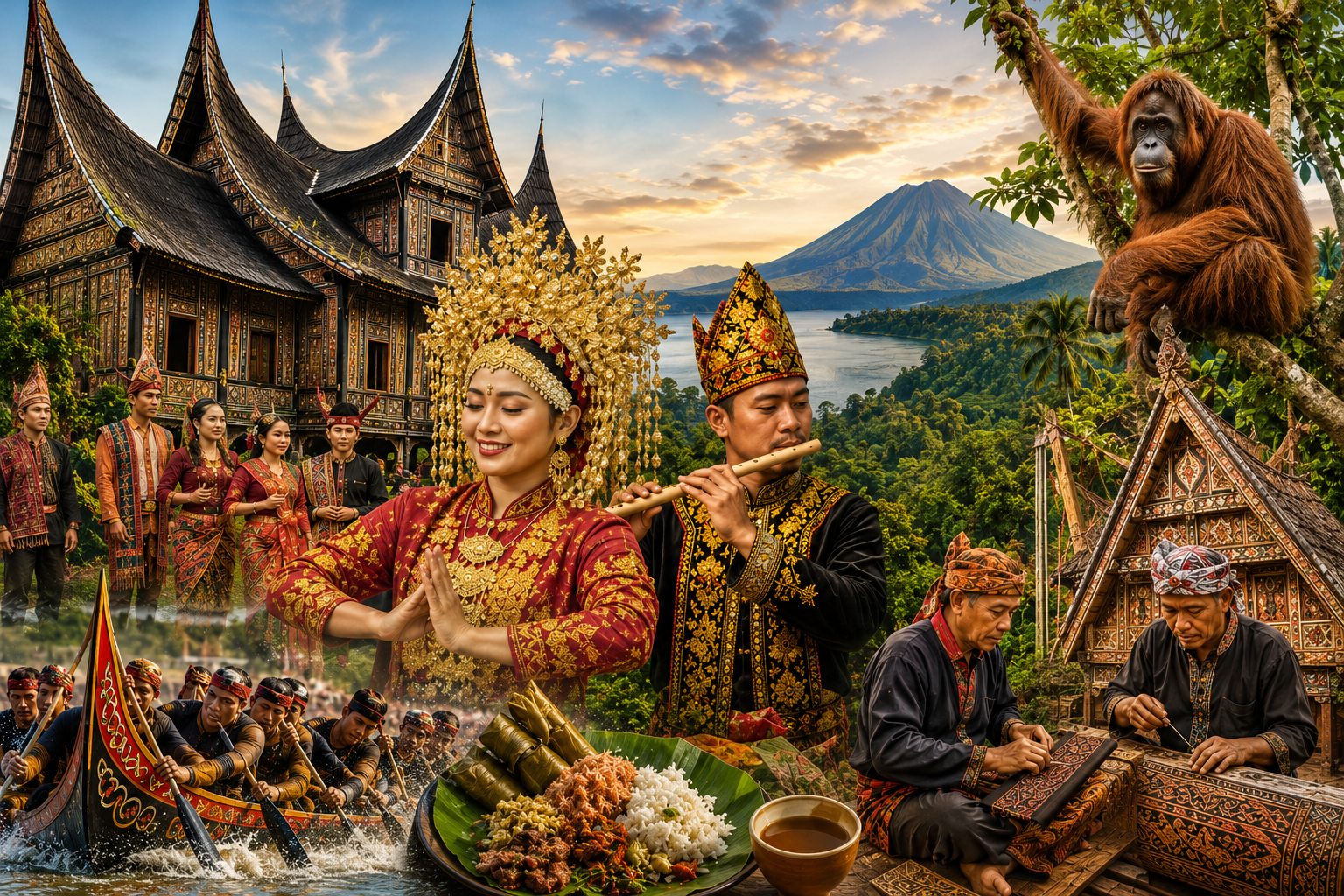
Traditional Music of Sumatra
Music has always been an essential part of Sumatra culture, accompanying ceremonies, weddings, harvest celebrations, religious events, and community gatherings. Every ethnic group has developed its own musical traditions using instruments made from wood, bamboo, animal skin, and bronze.
Among the Batak people, the Gondang ensemble is one of the most important forms of traditional music. It combines drums, gongs, flutes, and other percussion instruments to create rhythmic performances during ceremonies and cultural festivals. Gondang music is often performed alongside the Tor-Tor Dance and symbolizes harmony, gratitude, and respect for ancestors.
In Aceh, traditional music is closely connected to Islamic culture. Rhythmic chanting and synchronized body movements accompany performances such as the Saman Dance, creating an energetic and deeply meaningful cultural expression.
The Minangkabau people use instruments such as the Saluang, a bamboo flute that produces soft, melodic sounds. Combined with traditional singing and storytelling, Saluang performances reflect themes of love, nature, and everyday life.
Visitors traveling through Sumatra can often enjoy live musical performances during festivals, village celebrations, and cultural events, providing an authentic glimpse into the island’s rich artistic traditions.
Traditional Dances of Sumatra
Dance is one of the most captivating aspects of Sumatra culture, with every region preserving performances that have been passed down for generations.
Tor-Tor Dance
The Tor-Tor Dance is one of the most famous dances of the Batak people. Traditionally performed during weddings, funerals, and important community ceremonies, Tor-Tor features graceful hand movements and coordinated steps accompanied by Gondang music.
The dance symbolizes communication, respect, unity, and gratitude. Today, visitors around Lake Toba frequently have the opportunity to participate in Tor-Tor performances, making it an unforgettable cultural experience.
Saman Dance
Originating in Aceh, the Saman Dance has gained worldwide recognition for its extraordinary synchronization and teamwork. Dancers sit in a straight line while performing rapid hand movements, rhythmic clapping, and coordinated body motions without musical instruments.
Recognized by UNESCO as an Intangible Cultural Heritage, Saman represents discipline, cooperation, spirituality, and community values.
Plate Dance (Tari Piring)
The Plate Dance, or Tari Piring, originates from West Sumatra. Dancers skillfully balance plates in their hands while performing fast and energetic movements accompanied by traditional music.
Originally performed as part of harvest celebrations, the dance has become one of Indonesia’s best-known cultural performances and is regularly showcased during festivals and international events.
Traditional Karo Dance
The Karo people also preserve a variety of ceremonial dances performed during weddings and traditional celebrations. These dances emphasize harmony between families and strengthen community relationships.
Festivals and Cultural Celebrations
Throughout the year, communities across Sumatra celebrate festivals that preserve local traditions and strengthen cultural identity.
Some of the most popular celebrations include traditional weddings, harvest festivals, religious holidays, music festivals, and regional cultural exhibitions. During these events, visitors can witness traditional dances, music performances, local crafts, and authentic culinary specialties.
Lake Toba hosts cultural festivals featuring Batak music, Ulos weaving demonstrations, and traditional boat races. West Sumatra celebrates Minangkabau heritage through dance performances, culinary exhibitions, and cultural competitions. Aceh organizes Islamic cultural festivals that highlight religious traditions, local arts, and historical heritage.
These festivals provide excellent opportunities for travelers to interact with local communities and gain a deeper understanding of Sumatra’s diverse cultural landscape.
Traditional Food of Sumatra
No exploration of Sumatra culture would be complete without experiencing its extraordinary cuisine. The island is famous for bold flavors, aromatic spices, fresh herbs, and recipes that have been perfected over centuries.
Rendang
Perhaps the most famous dish from Sumatra is Rendang, originating from the Minangkabau people of West Sumatra. Slow-cooked for hours in coconut milk and a rich blend of spices, Rendang has earned international recognition as one of the world’s most delicious foods.
Soto Medan
This creamy coconut-based soup from Medan combines chicken or beef with aromatic spices, crispy potatoes, boiled eggs, and fresh herbs. Its rich flavor makes it one of North Sumatra’s signature dishes.
Mie Aceh
Aceh is famous for its spicy noodle dish known as Mie Aceh, served with beef, seafood, or chicken and flavored with Middle Eastern and Indian-inspired spices that reflect Aceh’s long trading history.
Arsik
The Batak community prepares Arsik, a traditional fish dish seasoned with turmeric, ginger, torch ginger flower, and local spices. It is commonly served during weddings and family celebrations.
Bika Ambon
Despite its name, Bika Ambon originates from Medan. This sweet cake is known for its soft, honeycomb-like texture and fragrant aroma, making it one of the city’s most popular souvenirs.
Visitors to Sumatra will also discover numerous regional specialties, tropical fruits, traditional desserts, and local coffee varieties, each reflecting the island’s cultural diversity.
Arts and Handicrafts
Artistic traditions remain an important part of everyday life throughout Sumatra. Skilled artisans continue to preserve techniques that have been passed down through generations.
Handwoven textiles such as Ulos from the Batak people and Songket from Malay and Minangkabau communities are among the island’s finest cultural treasures. These fabrics require weeks or even months to complete and are worn during weddings, ceremonies, and important celebrations.
Wood carving is another remarkable tradition, particularly among Batak and Nias communities. Traditional houses, ceremonial objects, and decorative panels are often adorned with intricate carvings representing protection, prosperity, and ancestral wisdom.
Other popular handicrafts include bamboo weaving, pottery, handmade jewelry, rattan products, traditional musical instruments, and natural fiber baskets. Purchasing these locally made products helps support village artisans and contributes to the preservation of Sumatra’s cultural heritage.
Languages Spoken in Sumatra
Although Bahasa Indonesia is the national language and widely spoken throughout the island, Sumatra is home to dozens of regional languages and dialects.
Some of the most widely spoken include:
- Batak languages
- Karo language
- Mandailing language
- Minangkabau language
- Acehnese
- Malay dialects
- Nias language
- Mentawai languages
Many local people are bilingual or multilingual, speaking both their regional language and Bahasa Indonesia. In popular tourist destinations such as Bukit Lawang, Lake Toba, Berastagi, and Medan, English is increasingly spoken by guides, hotel staff, and tourism operators.
Learning simple Indonesian greetings such as Selamat Pagi (Good Morning), Terima Kasih (Thank You), and Apa Kabar? (How are you?) is a wonderful way to show respect and connect with local communities during your journey across Sumatra.
Religion and Traditional Beliefs
Religion has played a significant role in shaping Sumatra culture for centuries. Today, the island is home to a diverse population that practices Islam, Christianity, Buddhism, Hinduism, and indigenous belief systems. Despite these differences, many communities share common values such as respect for family, hospitality, cooperation, and harmony with nature.
Islam is the predominant religion across much of Sumatra, particularly in Aceh, West Sumatra, and Riau. Aceh, often called the “Veranda of Mecca,” has a long history as one of Southeast Asia’s earliest centers of Islamic learning. Magnificent mosques, Islamic schools, and religious festivals are central to daily life in the region.
Christianity is widely practiced among many Batak communities around Lake Toba. Historic churches stand alongside traditional Batak villages, illustrating how religious beliefs and ancestral customs continue to coexist. Religious celebrations are often accompanied by traditional music, communal meals, and family gatherings.
In remote areas, some indigenous communities still maintain ancestral beliefs that emphasize the spiritual connection between humans and the natural world. Forests, rivers, mountains, and wildlife are often regarded with deep respect, reinforcing the importance of environmental conservation.
Cultural Tourism in Sumatra
One of the best ways to experience Sumatra culture is through cultural tourism. Rather than simply visiting famous attractions, travelers have the opportunity to engage directly with local communities and participate in authentic cultural experiences.
Across the island, visitors can join traditional cooking classes, learn about handwoven textiles, watch skilled artisans create wood carvings, or attend local ceremonies and festivals. Staying in family-owned guesthouses or eco-lodges also provides valuable insight into daily village life while supporting local economies.
Community-based tourism has become increasingly important in many parts of Sumatra. Local guides share stories about their history, customs, and traditions while encouraging responsible travel practices that protect both cultural heritage and the natural environment.
Bukit Lawang: Where Culture Meets Nature
Although Bukit Lawang is internationally famous for its orangutan trekking experiences in Gunung Leuser National Park, it is also an excellent destination for discovering North Sumatra’s cultural heritage.
The village is home to friendly local communities, many of whom belong to the Batak and Malay ethnic groups. Visitors are welcomed with genuine hospitality and have opportunities to experience traditional food, local markets, riverside village life, and cultural performances.
Many trekking guides are lifelong residents who possess extensive knowledge of both the rainforest and the traditions of their communities. During a jungle trek, visitors often learn not only about wildlife but also about medicinal plants, local folklore, and the historical relationship between people and the forest.
Choosing responsible tour operators helps support local families while contributing to the conservation of the critically endangered Sumatran orangutan and its rainforest habitat.
Lake Toba: The Heart of Batak Culture
No cultural journey through Sumatra would be complete without visiting Lake Toba, one of Indonesia’s most iconic destinations.
Formed by a massive volcanic eruption approximately 74,000 years ago, Lake Toba is now the cultural heartland of the Batak people. Traditional villages such as Tomok and Ambarita preserve centuries-old customs, architecture, and ceremonial traditions.
Visitors can explore beautifully carved Batak houses, observe demonstrations of Ulos weaving, watch Tor-Tor dance performances, and learn about the unique Marga clan system that continues to shape Batak society today.
The island of Samosir, located in the center of Lake Toba, offers museums, historical sites, local handicraft markets, and breathtaking scenery, making it one of the best places to immerse yourself in Sumatra culture.
West Sumatra and the Minangkabau Heritage
West Sumatra is another cultural treasure that showcases the remarkable traditions of the Minangkabau people.
The region’s picturesque landscapes are dotted with elegant Rumah Gadang houses, rice terraces, volcanic mountains, and charming villages. Visitors can explore Bukittinggi, one of the island’s most attractive cultural cities, where museums, traditional markets, and historical landmarks celebrate Minangkabau history.
Food lovers will also appreciate the opportunity to taste authentic Rendang, Gulai, Sate Padang, and many other regional specialties prepared using recipes passed down through generations.
Sustainable Tourism and Cultural Preservation
Protecting Sumatra culture requires a balance between tourism, economic development, and heritage conservation. Fortunately, many communities across the island are actively working to preserve their traditions while welcoming responsible visitors.
Eco-tourism projects encourage travelers to support locally owned accommodations, purchase handmade crafts, hire licensed local guides, and participate in cultural activities that directly benefit village communities.
These initiatives not only strengthen local economies but also encourage younger generations to continue practicing traditional music, dance, weaving, wood carving, and storytelling.
Responsible tourism also contributes to environmental conservation by protecting rainforests, wildlife habitats, rivers, and national parks that have supported local communities for centuries.
Travel Tips for Experiencing Sumatra Culture
To enjoy an authentic and respectful cultural experience, consider the following tips:
- Dress modestly when visiting villages, temples, churches, and mosques.
- Always ask permission before photographing local people or religious ceremonies.
- Support local businesses by purchasing handmade products directly from artisans.
- Learn a few simple Indonesian phrases to communicate with local communities.
- Respect local customs, traditions, and religious practices.
- Hire experienced local guides who can explain the history and significance of cultural sites.
- Dispose of waste responsibly and help protect Sumatra’s natural environment.
- Be open to trying regional cuisine and participating in traditional activities.
Small acts of respect create meaningful cultural exchanges and contribute to sustainable tourism throughout the island.
Frequently Asked Questions About Sumatra Culture
What is Sumatra culture known for?
Sumatra culture is known for its diverse ethnic groups, traditional architecture, colorful festivals, unique dances, delicious cuisine, handwoven textiles, and strong cultural traditions that have been preserved for generations.
Which ethnic groups live in Sumatra?
Some of the largest ethnic groups include the Batak, Minangkabau, Acehnese, Malay, Karo, Mandailing, Nias, Mentawai, and many others.
What is the most famous traditional food from Sumatra?
Rendang from West Sumatra is internationally recognized as one of the world’s most famous and flavorful traditional dishes. Other popular foods include Soto Medan, Mie Aceh, Arsik, Gulai, and Bika Ambon.
Where can I experience authentic Sumatra culture?
Excellent cultural destinations include Lake Toba, Bukit Lawang, Berastagi, Bukittinggi, Padang, Banda Aceh, Samosir Island, Nias Island, and several traditional villages across North and West Sumatra.
Is Sumatra safe for cultural tourism?
Yes. Most cultural destinations in Sumatra are welcoming and safe for visitors. As with any travel destination, respecting local customs, following your guide’s advice, and practicing responsible tourism will help ensure a positive experience.
Conclusion
Sumatra culture is one of Southeast Asia’s richest and most diverse cultural treasures. Across the island, travelers encounter ancient traditions, welcoming communities, magnificent architecture, vibrant festivals, and extraordinary culinary experiences that reflect centuries of history and cultural exchange.
Whether you are exploring the traditional Batak villages surrounding Lake Toba, admiring the iconic Rumah Gadang houses of West Sumatra, discovering the Islamic heritage of Aceh, or visiting the rainforest communities of Bukit Lawang, every journey offers a deeper appreciation of Indonesia’s remarkable cultural diversity.
Beyond its breathtaking landscapes and world-famous wildlife, Sumatra invites visitors to connect with the people who have shaped the island’s identity for generations. By embracing responsible tourism, supporting local communities, and respecting traditional customs, travelers play an important role in preserving this extraordinary heritage for future generations.
If you are searching for an authentic destination where culture, history, nature, and adventure come together, Sumatra is one of the most rewarding places to explore in Indonesia. From its diverse tribes and colorful traditions to its unforgettable hospitality and timeless heritage, Sumatra promises an inspiring journey that will remain with you long after your travels have ended.